Cool belt
Illinois yard facts: grass, season and the rules that apply
Most Illinois lawns are cool-season grass that goes dormant in hot, dry weather. Here is how that shapes the jobs, and which paid lawn work needs a state license.
By LawnElm Editorial Team Updated 6 min read
- Grass belt
- Cool-season
- Common grasses
- Bluegrass, tall fescue
- Spray for hire
- License required
Short version
Illinois Extension says most Illinois lawns are cool-season grasses, mainly Kentucky bluegrass, turf-type tall fescue and fine fescue. The Illinois Department of Agriculture licenses anyone who applies pesticides to lawns for hire, and the state's Lawn Care Products Application and Notice Act treats fertilizer as a lawn care product, with lawn markers and information that applicators must give.
Illinois at a glance
Grass and climate
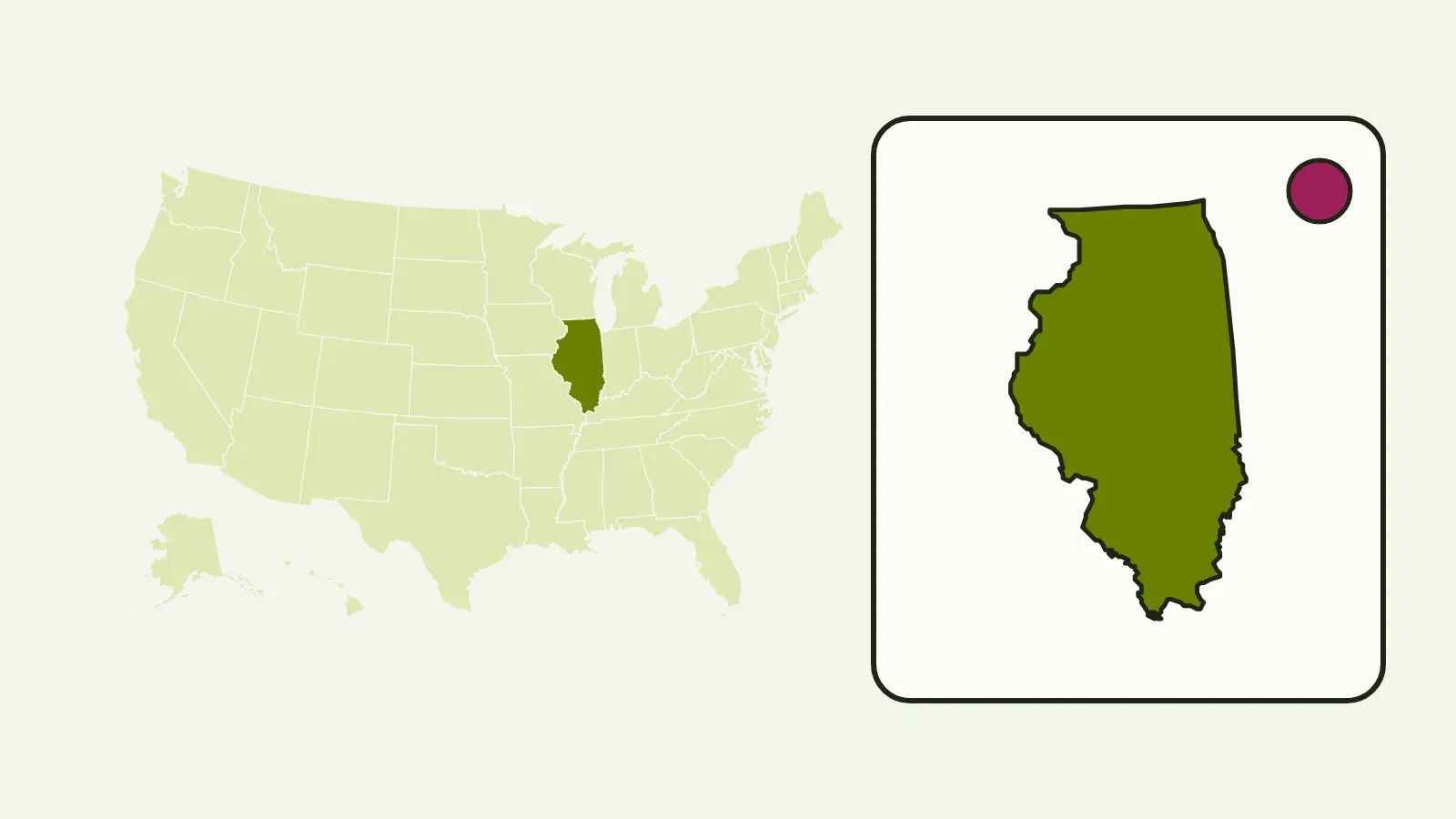
University of Illinois Extension says most turfgrasses in Illinois are non-native cool-season grasses. It names Kentucky bluegrass, turf-type tall fescue and fine fescue for lawns, and bentgrass for golf courses. That is why Illinois sits in the cool belt on the state map: these grasses grow hardest in spring and fall, and the jobs on your yard calendar follow that rhythm.
Extension also says most Illinois lawns go dormant during hot, dry weather. If you water, it advises watering consistently through summer rather than on and off. A lawn that has browned in a dry spell may be resting, so ask your county Extension office before you replace it.
Illinois is long from north to south, and Extension's spring advice shows it. Its crabgrass preventer timing uses April 1 as a guide for Central Illinois, a week or two sooner in Southern Illinois and a week or two later in Northern Illinois. Expect any calendar written for the middle of the state to run early or late at the edges.
Mowing and feeding
Illinois Extension says cool-season lawns compete better with weeds when kept at 2 to 3 inches, and that turf-type tall fescue does better at 3 to 4 inches. Its mowing mantra for cool-season lawns is a 2- to 4-inch cut, mowing often enough never to remove more than a third of the leaf blade at once, and keeping blades sharp. See lawn mowing for how the one-third rule sets your schedule.
- Spring: once the grass is tall enough to mow, start mowing. Extension says not to wait.
- Seeding: finish spring seeding by mid-April. If you can wait, Extension says the best time to seed a cool-season lawn is August 15 through September 15.
- Fertilizer: skip early spring, since it can stunt roots, and wait until mid-May. Slow-release products are less likely to burn the turf. If you feed only once a year, Extension recommends late summer to early fall.
Extension does not recommend doing every spring task at once. It says combined products such as weed-and-feed usually give up good timing for one of the two jobs. Read the label, apply only the amount it states, and use the lawn supplies tool to turn a label rate into bags.
Who regulates what
Illinois Extension's pesticide program says anyone who applies pesticides for hire in Illinois must be licensed, and that this includes general-use products. The Illinois Department of Agriculture (IDOA) gives the exams and issues the license. Every commercial licensee passes the General Standards exam, and an applicator adds a category exam. Extension lists Turfgrass for lawns and Ornamentals for trees, shrubs and flowers, and says residential lawn care businesses most often need both.
A company needs at least one licensed Commercial Applicator. A Commercial Operator applies at the job site under that applicator's supervision, only in the categories on the applicator's license. The applicant must also show proof of financial responsibility (insurance) to IDOA, and Extension says a person may not start applying until IDOA issues the license. If a crew sprays your lawn, ask for the license and which categories it covers.
Fertilizer is handled differently. Extension's FAQ says a license is not required to apply fertilizer alone. But the state's Lawn Care Products Application and Notice Act (415 ILCS 65) counts both fertilizers and pesticides as lawn care products, organic ones included. According to Extension's summary for applicators, lawn markers go up at the point of entry right after an application. The marker is a white 4-inch by 5-inch sign on a support at least 12 inches above the turf, with lettering that tells people to stay off the grass until dry and gives the company's phone number. The resident may remove it 24 hours after the application.
Applicators must also be able to say what was applied, why, how much and what reentry limits apply, and they provide the label and safety data sheet on request. A neighbor next to the site may ask for prior notice by giving a name, address and phone number, and the applicator then gives written or verbal notice at least one day ahead. Extension adds that people in apartments, condos and HOAs must make that request themselves.
The pages used for this guide do not list a statewide limit on how much fertilizer a homeowner may apply, and they do not cover whether Illinois licenses landscape contractors or tree crews. Ask your city and the IDOA if that matters for your job.
Call 811 and local rules
Call 811 before you dig a post hole, plant a tree or build a deck. An Illinois Extension release from 2021 says to call at least two full business days before digging, calls the service free, and says utilities do not mark private lines such as sprinkler lines or a gas line to a grill. It suggests pre-marking the dig area with white paint or flags, and keeping 18 to 24 inches from utility marks when you dig. Illinois' one-call center is JULIE. The steps are in call 811 before you dig.
Cities, villages and homeowners' associations can add rules for grass height, watering and yard work. No particular ordinance is covered here, so read yours or ask the local office. The guide to HOA and city yard rules lists what to look for.
Hiring a crew in Illinois
Mowing does not need a pesticide license, but spraying does, and the state notice rules apply to fertilizer visits too. Ask any company that applies weed killer, grub control or fertilizer for its license number, the product and rate in writing, and how it will mark the lawn and notify neighbors. The guide to hiring a lawn crew lists what a written quote should say.
Questions people ask
What kind of grass do most Illinois lawns have?
Cool-season grasses. Illinois Extension names Kentucky bluegrass, turf-type tall fescue and fine fescue, and says most turfgrasses in the state are non-native cool-season species.
How tall should I mow an Illinois lawn?
Illinois Extension recommends a 2- to 4-inch cut for cool-season lawns, 2 to 3 inches for most, and 3 to 4 inches for turf-type tall fescue. Never remove more than a third of the blade at one mowing.
When should I fertilize in Illinois?
Extension says to wait until mid-May rather than feed in early spring. If you fertilize only once a year, it recommends late summer to early fall.
Does a lawn crew need a license to spray in Illinois?
Yes. Illinois Extension says anyone who applies pesticides for hire must be licensed through the Illinois Department of Agriculture, general-use products included. Applying fertilizer alone does not need a license.
Sources
- Lawn Care Business, Pesticide Licensing To-Do List (Illinois Extension, Pesticide Safety Education Program)
- Starting a lawn care business? Here's how to get licensed for pesticide application (Illinois Extension, July 16, 2026)
- The Illinois Lawn Care Application Notice Act, communication is key (Illinois Extension, August 6, 2026)
- Lawn Care Products Application and Notice Act, 415 ILCS 65 (Illinois General Assembly)
- Spring lawn care: What should you really be doing? (Illinois Extension, March 5, 2026)
- Managing lawns with ecology in mind (Illinois Extension, August 27, 2026)
- What lurks under the dirt?: Call before you dig (Illinois Extension, August 1, 2021)
Checked on November 20, 2026. Licensing rules and local ordinances change; confirm with the Illinois Department of Agriculture, your county Extension office and your city before you hire or spray. The 811 notice period comes from a 2021 release, so confirm it with JULIE.
Next in the yard
-

Yard job
Lawn mowing
How tall to mow, how often, and what a weekly visit includes.
-

Yard job
Lawn fertilizing
When to feed cool- and warm-season lawns, how to size a feeding, and what rules apply.
-

Guide
How to hire a lawn crew
Licenses, insurance and written quotes to check before a lawn or landscape crew starts work.