Cool belt
Montana yard facts: grass, season and the rules that apply
Montana lawns are cool-season grass, with the big feedings in late summer and fall. Here is how that shapes the jobs, and who regulates the work.
By LawnElm Editorial Team Updated 6 min read
- Grass belt
- Cool-season
- Common grasses
- Bluegrass, fescue
- Spray for hire
- License required
Short version
Montana State University Extension builds Montana lawns from Kentucky bluegrass, fescue and perennial ryegrass, and says zoysiagrass and bermudagrass are not appropriate for Montana lawns. Its maintenance guide puts the key feedings at Memorial Day, Labor Day and Indigenous Peoples Day. The Montana Department of Agriculture requires a license from anyone in the business of applying pesticides, and registers fertilizer products.
Montana at a glance
Grass and climate
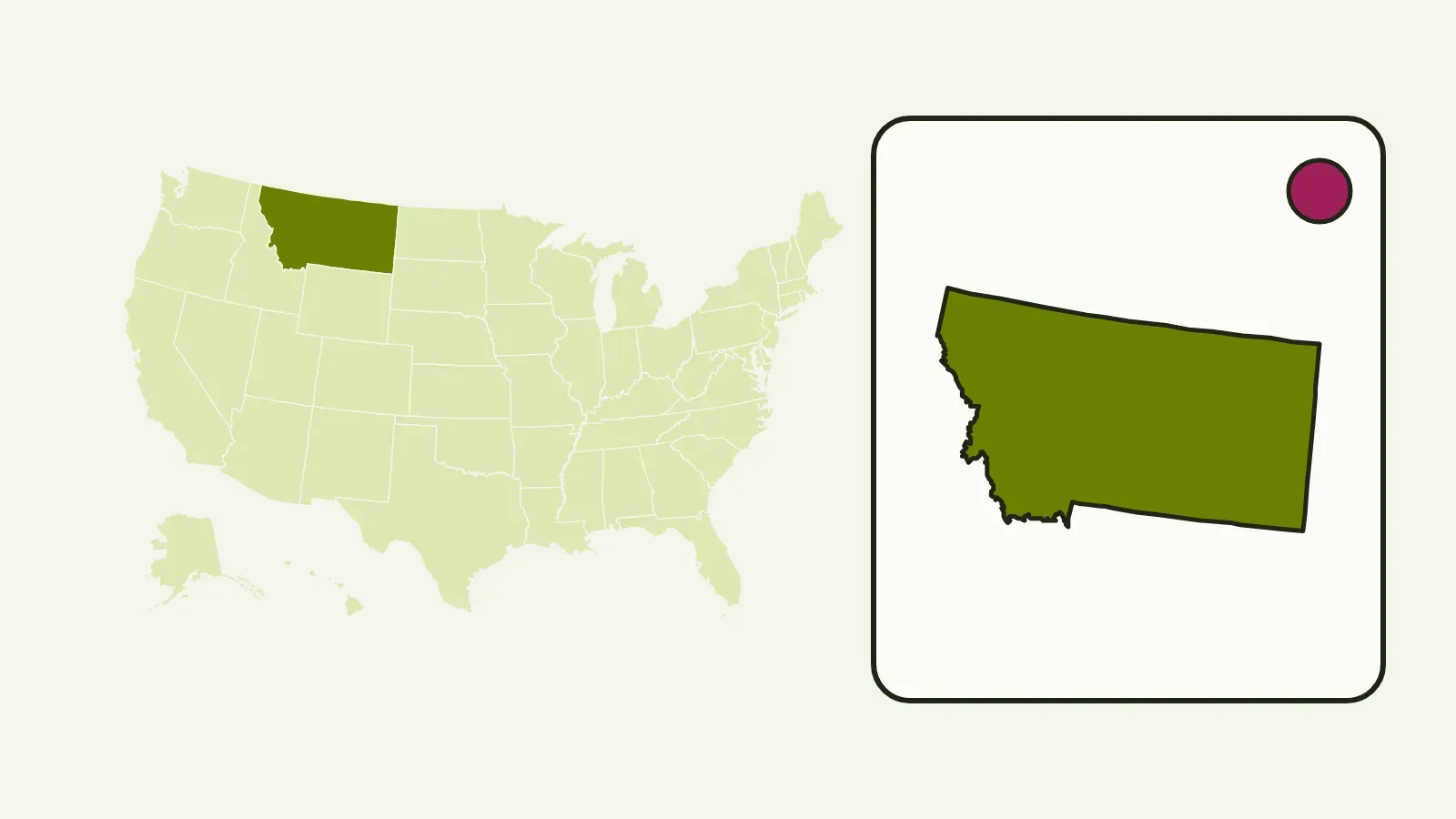
MSU Extension's planting guide recommends a mix for general lawn use under moderate irrigation: Kentucky bluegrass or one of its improved varieties, creeping red fescue or Chewings fescue, and perennial ryegrass. A typical mix is about 60 percent bluegrass, 30 percent fescue and 10 percent perennial ryegrass, and the ryegrass is optional because it is not permanent. That is why Montana sits in the cool belt on the state map. The guide says lawn mixes with a large share of perennial or annual ryegrass make inferior lawns in Montana, and that zoysiagrass and bermudagrass, though advertised as cold- and drought-tolerant, are not appropriate grasses for Montana lawns.
Dry ground changes the advice. For semi-dryland lawns in eastern Montana, MSU suggests sheep fescue, hard fescue or the newer turf-type tall fescues, planted alone and not in a mix. In very dry conditions or non-irrigated lawns it lists crested wheatgrass, streambank wheatgrass, meadow bromegrass and smooth bromegrass, which brown in drought and should not be mowed below 3 inches. Buffalograss and blue grama grow with little moisture and can be mowed at about 2.5 inches, MSU says, but they green up slowly in spring, brown soon after the first cold weather and cannot compete with weeds or cool-season grasses in high-rainfall or irrigated lawns.
- Bluegrass, fescue and ryegrass mixes are the standard lawn in MSU's guides.
- Shade calls for the same species with fescue making up most of the mix, per MSU.
- Seeding time is late April and May, but MSU says mid-August to mid-September, around Labor Day, is better.
Mowing and feeding
MSU Extension's lawn maintenance guide, revised in August 2023, says to mow often enough to remove only one-third of the grass blade and to leave the clippings on the lawn. It gives 2.5 to 3 inches as the optimum height for bluegrass, fescue and ryegrass mixes, and says higher heights in the warmer summer months allow deeper roots and fewer weeds. Fescues and ryegrasses thin when mowed short. See lawn mowing for how the one-third rule sets your schedule.
For feeding, the guide says that for most Montana conditions a lawn gets 2 to 4 pounds of actual nitrogen per 1,000 square feet per year, in two to three applications, with no more than 1.5 pounds at one time. It names Memorial Day, Labor Day and Indigenous Peoples Day as good rules of thumb, with the last one after the final mowing and about four weeks before the soil freezes. If you feed only once or twice a season, MSU says the two fall applications are the key ones. The lawn supplies tool turns a rate like that into bags, and the label on your bag comes first.
For water, MSU says to water in the early morning, deeply and infrequently. It puts a well-kept bluegrass lawn's need at 1 to 1.5 inches a week early and late in the season, and as much as 2.5 inches a week in mid-summer for most of the state. Subtract the rain since the last watering. Local water systems may add their own limits; see lawn watering and irrigation.
Who regulates what
The Montana Department of Agriculture's commercial applicator page says any person in the business of applying pesticides must get an applicator's license from the department. To get one you pass a core exam and category-specific exams, complete an application and pay the licensing fee. Commercial applicators generally must carry liability insurance and show proof on request. Licenses expire every December 31 and must be renewed before pesticides are applied, and applicators keep application records for two years.
The department's classifications include Ornamental and Turf Pest Control, which covers anyone using or supervising the use of pesticides to control pests in the maintenance and production of ornamental trees, shrubs, flowers and turf. If a crew sprays your lawn, ask for its license and which categories it covers.
For fertilizer, the department says all fertilizer and soil amendment products require registration and that registrations expire December 31. The department points to Title 80, Chapter 10 of the Montana Code Annotated. Registration covers products sold in the state. The pages this article read do not say whether the state limits how a homeowner applies lawn fertilizer, so ask the department and your city.
Call 811 and local rules
Montana's excavation law, Section 69-4-503 of the Montana Code Annotated (2025), says an excavator must notify the owners of underground facilities through a notification center before beginning an excavation. A notice covers work that starts within 10 days and finishes within 30 days. After the notice, the facility owner must locate and mark within 2 business days, or within 5 business days for an engineering locate request. If you have not dug within 30 days of the marking, you must request a new locate. If you find a line that was not marked, stop digging nearby and tell the owner or the center. This article did not check the law's definition of an excavator, so confirm with the 811 center whether your own project is covered. The steps are in call 811 before you dig.
Cities, counties, water systems and homeowners' associations can add rules for grass height, watering and yard work. No particular ordinance is covered here, so read yours or ask the local office. The guide to HOA and city yard rules lists what to look for.
Hiring a crew in Montana
Spraying for hire needs a licensed applicator, so ask any company that offers weed, grub or insect treatments for its license number and for the product and rate in writing. The pages this article read do not say whether Montana licenses mowing, landscaping or tree work at the state level, so ask your city or county before you assume a crew needs, or does not need, a local license. The guide to hiring a lawn crew lists what a written quote should say.
Questions people ask
What kind of grass do most Montana lawns have?
MSU Extension recommends mixes of Kentucky bluegrass, creeping red or Chewings fescue and perennial ryegrass for general lawns. For dry eastern Montana it suggests sheep fescue, hard fescue or turf-type tall fescue.
Can I grow bermudagrass or zoysiagrass in Montana?
MSU Extension says zoysiagrass and bermudagrass are not appropriate grasses for Montana lawns, even though they are advertised as cold- and drought-tolerant.
When do I fertilize a Montana lawn?
MSU Extension gives Memorial Day, Labor Day and Indigenous Peoples Day as good rules of thumb, and says the two fall applications are the key ones if you feed only once or twice. Exact times vary across the state.
Does a lawn crew need a license to spray in Montana?
Yes. The Montana Department of Agriculture says any person in the business of applying pesticides must have an applicator's license from the department.
Sources
- Maintaining Successful Lawns in Montana (MSU Extension, MT202004AG, revised August 2023)
- Planning and Planting Successful Lawns in Montana (MSU Extension, MT202003AG, revised April 2020)
- Commercial Applicators (Montana Department of Agriculture)
- Fertilizer Product Registration (Montana Department of Agriculture)
- 69-4-503, Notification, locating and marking (Montana Code Annotated 2025)
Checked on November 20, 2026. Licensing rules and local ordinances change; confirm with the Montana Department of Agriculture, your county extension office and your city before you hire or spray.
Next in the yard
-

Yard job
Lawn fertilizing
When to feed cool- and warm-season lawns, how to size a feeding, and what rules apply.
-

Yard job
Lawn watering and irrigation
How much water lawns need by belt, when to run sprinklers, and what an irrigation quote lists.
-

Guide
Call 811 before you dig
How the free 811 locate works, why notice periods differ by state, and who calls when a crew digs.