Warm belt
Louisiana yard facts: grass, season and the rules that apply
Louisiana lawns are warm-season grass that grows from March to October and goes dormant in winter. Here is how that shapes the jobs, and which paid yard work needs a state license.
By LawnElm Editorial Team Updated 6 min read
- Grass belt
- Warm-season
- Common grasses
- Bermuda, St. Augustine
- Spray for hire
- License required
Short version
Louisiana lawns are warm-season grasses such as bermudagrass, centipedegrass, St. Augustinegrass and zoysiagrass. LSU AgCenter shows them growing from March through October and dormant from November through February. The Louisiana Department of Agriculture and Forestry licenses businesses that apply pesticides for hire and registers fertilizer products, and LSU AgCenter says paid landscape work beyond basic yard work generally needs a state license.
Louisiana at a glance
Grass and climate
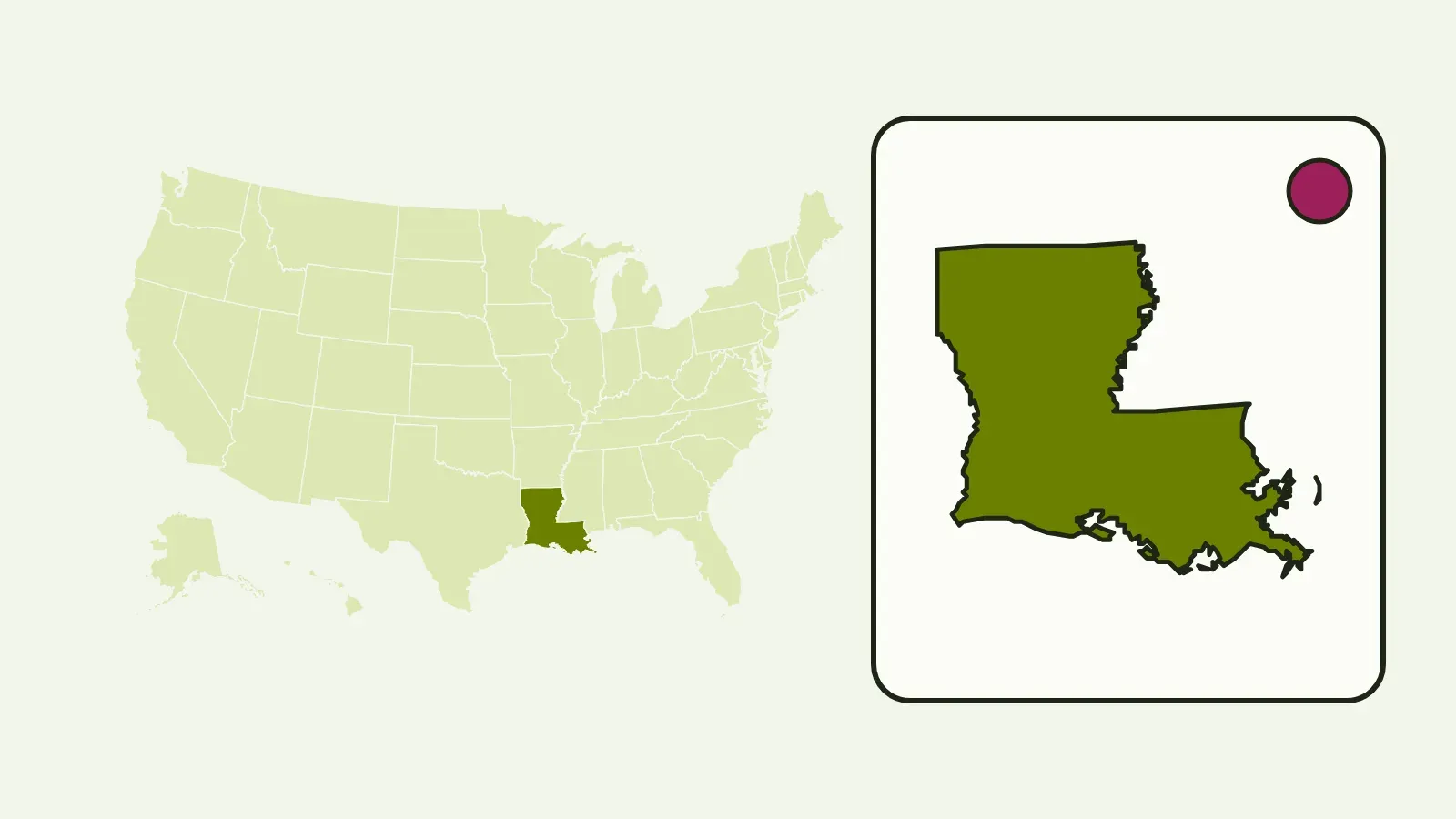
LSU AgCenter's home-lawn mowing guide lists four lawn grasses for Louisiana: bermudagrass, centipedegrass, St. Augustinegrass and zoysiagrass. All four are warm-season grasses, which is why Louisiana sits in the warm belt on the state map. LSU's lawn pages also call centipedegrass a popular lawn grass in the state.
Warm-season grasses grow in the warm months and rest in the cold ones. LSU AgCenter's mowing guide marks March through October as the active growth season and November through February as dormant. In fall, an LSU horticulturist says warm-season grasses are slowing down and trying to go dormant, and that the grass should be allowed to do so. The jobs on your yard calendar follow that cycle, not the date.
The state has two cold hardiness zones. LSU's culture calendar for warm-season grasses covers both, and says lawn jobs in north and south Louisiana differ by two to four weeks in when they start and end, because spring and fall arrive at different times. If you live near the line between the two, expect to adjust a calendar written for the other half of the state.
- Bermudagrass grows fast, so LSU says it may need mowing more often than a slower grass such as zoysiagrass.
- St. Augustinegrass is cut higher than the others, at 2.5 to 3 inches in LSU's table.
- Centipedegrass and zoysiagrass are cut at 1 to 2.5 inches. LSU publishes a separate fact sheet on centipede decline.
Mowing and feeding
LSU AgCenter says Louisiana homeowners may mow about once a week, or three to four times a month, during the growing season. Mowing a dormant lawn is generally not necessary. LSU also gives the one-third rule: never remove more than a third of the leaf blade in one mowing. It calls this a general guideline, and says that regular mowing at the right height matters more than measuring exactly one-third. See lawn mowing for how the rule sets your schedule.
| Grass | Mowing height |
|---|---|
| Bermudagrass | 1 to 2 inches |
| Centipedegrass | 1 to 2.5 inches |
| St. Augustinegrass | 2.5 to 3 inches |
| Zoysiagrass | 1 to 2.5 inches |
LSU AgCenter publishes a culture calendar for warm-season grasses, and that is the place to look for feeding dates for your part of the state. This page does not repeat feeding rates, because the calendar and your fertilizer label set them. The lawn supplies tool turns a label rate into bags. LSU also notes that large piles of clippings left on the lawn block light and thin the grass underneath.
Who regulates what
The Louisiana Department of Agriculture and Forestry (LDAF) licenses businesses that apply pesticides. Its commercial licensing page says a ground application business needs a Ground Owner Operator License, must employ at least one certified commercial pesticide applicator, must carry liability insurance and financial surety, and must register power spray equipment. Commercial applicators recertify every three years. The page separates this from structural pest control, which covers pests inside or within the structures of buildings.
LSU AgCenter explains what that means for a yard. State law requires anyone who applies herbicides, insecticides, fungicides or other pesticides to someone else's landscape for a fee to hold a pesticide applicator's license and a commercial applicator certification. Applicators for lawns and landscape plants take a general standards exam and the ornamental and turf pest control exam. If a crew sprays your lawn, ask for the license and a copy of the certification.
Louisiana also licenses some landscape work that is not spraying. LSU AgCenter says general yard work such as mowing, edging and hand-weeding is the easiest to get into. For other paid landscape work, Louisiana generally requires a license. A Landscape Horticulturist license covers jobs such as preparing beds, installing plants or sod, and fertilizing, and it is earned by passing an LDAF exam. It does not allow selling a landscape design, which takes a Landscape Architect license. Arborists who prune, cable, fertilize or remove trees for pay need a state arborist license too.
LSU says an owner can have limited hedge trimming and tree pruning done under the owner's direction without a license, if the work is not on commercial property and any branch removed is two inches or less in diameter and within ten feet of the ground. For larger work, ask whether the crew holds the arborist license. See tree trimming.
For fertilizer itself, LDAF's fertilizer program covers registration, labeling and tonnage reporting for products sold in the state. The LDAF page does not list a statewide limit on how a homeowner applies lawn fertilizer, so check with your parish, city and homeowners' association.
Call 811 and local rules
Call 811 before you dig a post hole, plant a tree or build a deck, so utility lines are marked. The notice period is not stated on the pages listed below, so ask the 811 center how many working days it needs. The steps are in call 811 before you dig.
Parishes, cities, water systems and homeowners' associations can add rules for grass height, watering and yard work. No particular ordinance is covered here, so read yours or ask the local office. The guide to HOA and city yard rules lists what to look for.
Hiring a crew in Louisiana
Mowing and basic yard work do not need a license, but spraying does, and so does much other paid landscape work. Ask any company that plants, fertilizes, sprays or prunes for its license number and the product and rate in writing. LDAF's nursery and landscape licensing site, which LSU points to, lets you look up licensed individuals. The guide to hiring a lawn crew lists what a written quote should say.
Questions people ask
What kind of grass do most Louisiana lawns have?
Warm-season grasses. LSU AgCenter's mowing guide lists bermudagrass, centipedegrass, St. Augustinegrass and zoysiagrass, and its lawn pages call centipedegrass a popular choice.
When do I mow a lawn in Louisiana?
LSU AgCenter shows the active growth season as March through October, with the grass dormant from November through February. During the season it says to mow about once a week.
Does a lawn crew need a license to spray in Louisiana?
Yes. LSU AgCenter says state law requires a pesticide applicator's license and commercial applicator certification for anyone who applies pesticides to others' landscapes for a fee. LDAF licenses the business and certifies the applicators.
Does a mowing crew need a state license?
LSU AgCenter says general yard work, including mowing, edging and hand-weeding, can be done without a state license. Other paid landscape work, such as planting, installing sod and fertilizing, generally needs a Landscape Horticulturist license.
Sources
- The One-Third Mowing Rule (LSU AgCenter)
- Lawn cultural information (LSU AgCenter)
- Some Licenses and Certifications Related to Landscape Horticulture Work (LSU AgCenter)
- Commercial pesticide licensing (Louisiana Department of Agriculture and Forestry)
- Fertilizer (Louisiana Department of Agriculture and Forestry)
Checked on November 20, 2026. Licensing rules and local ordinances change; confirm with the Louisiana Department of Agriculture and Forestry, your parish extension office and your city before you hire or spray.
Next in the yard
-

Yard job
Lawn mowing
How tall to mow, how often, and what a weekly visit includes.
-

Yard job
Lawn fertilizing
When to feed cool- and warm-season lawns, how to size a feeding, and what rules apply.
-

Guide
How to hire a lawn crew
Licenses, insurance and written quotes to check before a lawn or landscape crew starts work.